
Solar explained ·
How Many Solar Panels an LA Home Needs: 9 to 40
A Los Angeles home using 500 to 2,000 kWh a month needs about 9 to 40 solar panels. See the math by monthly use, roof direction and electric car charging.
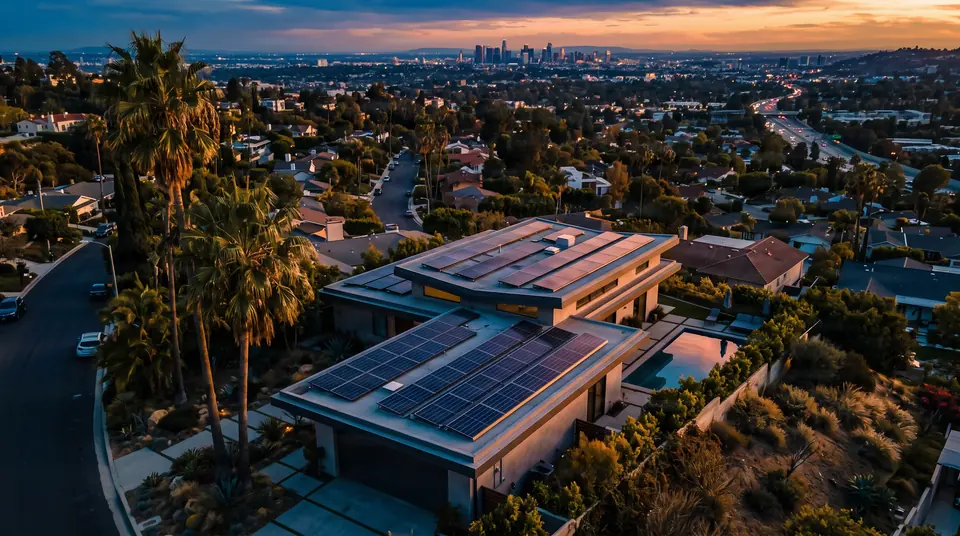
The short answer for a Los Angeles house: about 9 to 10 panels if you use 500 kWh a month, about 17 to 20 panels at 1,000 kWh a month, and about 34 to 40 panels at 2,000 kWh a month. The low number is for a roof that faces south. The high number is for a roof that faces east. Those counts assume 430 watt panels and are meant to cover the kilowatt-hours you use in a full year.
Below is where those numbers come from, so you can check them yourself. Every figure in this post comes from a source we opened and list at the bottom. Nothing here is a quote or a promise for your house. Your own count depends on your bill and your roof, and that is the part we do for you.
The 3 numbers that decide your panel count
The math is short. You need three numbers.
- How many kWh you use in a year. This is on your electric bill. Add up twelve months. One month is not enough, because a Valley house in August and the same house in March are two different stories.
- How many kWh one kilowatt of panels makes in a year on your roof. This depends on where you live and which way the roof faces.
- The size of one panel in watts. EnergySage, a solar marketplace, reports that almost every panel used today is rated at 400 watts or more, and that the most common size quoted on its marketplace in the first half of 2026 was 430 to 440 watts. We use 430 watts in this post.
The formula:
Panels = yearly kWh ÷ yearly kWh made per kW ÷ panel size in kW
A 430 watt panel is 0.43 kW. So a house that uses 12,000 kWh a year, on a roof where each kW makes 1,677 kWh a year, needs 12,000 ÷ 1,677 ÷ 0.43 = 16.6, which rounds up to 17 panels.
How much power a panel makes in Los Angeles
We ran the federal PVWatts calculator, the free tool from the national energy lab formerly called NREL, for a 1 kW system in Los Angeles (latitude 34.05, longitude -118.24). Settings: fixed roof mount, standard panels, a 20 degree roof tilt, and the tool's 14% system loss setting. The only thing we changed between runs was the direction the roof faces.
| Roof faces | kWh per year from 1 kW of panels | Compared with south |
|---|---|---|
| South | 1,677 | 100% |
| West | 1,484 | 88% |
| East | 1,410 | 84% |
| North | 1,165 | 69% |
Three things stand out.
- Direction matters more than neighborhood. We ran the same south-facing setup for West Hills in the west San Fernando Valley (latitude 34.20, longitude -118.60) and got 1,711 kWh per year. That is about 2% more than the central Los Angeles run. Turning the same roof from south to east costs about 16%.
- A north-facing roof needs far more panels. At 1,165 kWh per kW it makes about 31% less than south. That is why a good design puts panels on the south, west and east faces first.
- Summer and winter are not the same. In the south-facing Los Angeles run, 1 kW made about 173 kWh in August and about 100 kWh in December. Panels are sized on the full year, not on one month.
Shade from trees, chimneys or a taller house next door lowers these numbers. PVWatts does not know about your neighbor's palm tree. A real design does.
Panel count by monthly use, 500 to 4,000 kWh
This table uses the PVWatts numbers above and 430 watt panels. Counts are rounded up to the next whole panel. The kW column is for a south-facing roof.
| Average monthly use | Yearly use | System size (south) | Panels, south roof | Panels, west roof | Panels, east roof |
|---|---|---|---|---|---|
| 500 kWh | 6,000 kWh | 3.6 kW | 9 | 10 | 10 |
| 1,000 kWh | 12,000 kWh | 7.2 kW | 17 | 19 | 20 |
| 1,500 kWh | 18,000 kWh | 10.7 kW | 25 | 29 | 30 |
| 2,000 kWh | 24,000 kWh | 14.3 kW | 34 | 38 | 40 |
| 3,000 kWh | 36,000 kWh | 21.5 kW | 50 | 57 | 60 |
| 4,000 kWh | 48,000 kWh | 28.6 kW | 67 | 76 | 80 |
Some context for the left column. The U.S. Energy Information Administration reports that the average California home bought 503 kWh a month from its utility in 2024. The U.S. average that year was 863 kWh a month. The agency also notes that in states with a lot of rooftop solar, homes use more electricity than they buy, because some of it comes from their own roof. So if you already have a small system, your bill understates your real use.
A 4,000 kWh a month home is a very large user: a big house with a pool, heavy air conditioning and more than one electric car. 67 or more panels will not fit on many roofs. For a home like that, the honest answer is often a system that covers part of the use, placed on the best roof faces.
What about square footage, like a 3,000 sq ft home
People search for panel counts by house size. House size is a weak guide. Two 3,000 square foot homes on the same street can use very different amounts of power. One has gas heat, two people and no pool. The other has a pool pump, two air conditioners running all summer and two electric cars. The first may use 600 kWh a month and the second 2,000.
The bill settles it. Find your yearly kWh, then use the table above. If your use falls between two rows, the formula works for any number.
How many panels to charge a Tesla
The federal fuel economy site lists the 2025 Tesla Model 3 Long Range rear-wheel drive at about 25 kWh per 100 miles combined. The Federal Highway Administration's table of average annual miles per driver shows 13,476 miles a year.
| Step | Number |
|---|---|
| Miles per year | 13,476 |
| Electricity per 100 miles | about 25 kWh |
| Electricity per year for driving | about 3,320 kWh |
| System size needed, south roof in Los Angeles | about 2.0 kW |
| 430 watt panels | 5 |
So about 5 extra panels cover an average year of driving in that car on a south-facing Los Angeles roof. A bigger or less efficient electric car, or a longer commute, needs more. If you plan to buy an electric car in the next year or two, say so before the system is designed. Your past bills do not include a car you do not own yet.
5 things that change the count for your house
- Roof direction and tilt. As the table shows, east or west faces need roughly 13% to 19% more panels than south for the same yearly output.
- Shade. Trees and nearby buildings cut production. The loss is different for every roof.
- Usable roof space. Vents, skylights, chimneys and required fire setbacks take room. Sometimes the roof, not the bill, sets the limit.
- Your utility and rate plan. LADWP and Southern California Edison credit solar power under different rules. Covering 100% of your yearly kWh is not always the right target. Sometimes a smaller system, or a system with a battery, fits the rate plan better.
- Changes ahead. An electric car, a heat pump, a pool, or kids moving out all move the number.
This is why two installers can look at the same house and give two different panel counts. Ask each one what yearly kWh they designed for and what production per kW they assumed. Now you know what good answers look like.
How to find your own number in 10 minutes
- Pull your last twelve electric bills, or log in to your LADWP or SCE account and find the yearly usage.
- Add up the kWh for the year.
- Divide by 1,677 if your best roof face points south, 1,484 for west, or 1,410 for east. The result is the system size in kW.
- Divide that by 0.43 to get a rough count of 430 watt panels. Round up.
That gives you a fair rough number. It will not account for shade, roof layout or your rate plan.
Or skip the math and send your bill
Ray4Ever works one way. No visit to your house. No hours of talking. No pile of questions left behind. You send us every page of your electric bill, and we send back the final numbers for your home: the system size, the panel count, and where the panels go on your roof. Then you decide if solar works for you.
See how it works, read the common questions, or go straight to the form and send your bill.
Questions homeowners ask
How many solar panels does a Los Angeles home need for 1,000 kWh a month?
About 17 panels of 430 watts on a south-facing roof, about 19 on a west-facing roof and about 20 on an east-facing roof. That is based on the federal PVWatts calculator, which shows 1 kW of panels making about 1,677 kWh a year facing south in Los Angeles.
How many solar panels do I need for 2,000 kWh a month?
About 34 to 40 panels of 430 watts in Los Angeles, depending on which way the roof faces. That is a system of roughly 14 kW on a south-facing roof. Shade and roof space can change the count.
Does the size of my house tell me how many panels I need?
Not well. Two homes of the same size can use very different amounts of electricity. Your yearly kWh from twelve months of electric bills is the number that sets the panel count.
How many solar panels does it take to charge a Tesla?
About 5 panels of 430 watts on a south-facing Los Angeles roof for a 2025 Tesla Model 3 Long Range rear-wheel drive driven 13,476 miles a year. The federal fuel economy site lists that car at about 25 kWh per 100 miles.
How do I get the exact panel count for my home?
Send Ray4Ever every page of your electric bill. We work out the system size and panel count for your roof and your utility and send you the final numbers. No home visit and no long sales call.
Want your own numbers?
Send us your last electric bill. No visit, no hours of talking, no pressure. We send you the final numbers and you decide if solar works for you.
More from the blog
Solar explained ·
Calabasas Solar Guide: SCE Net Billing, Permits
Going solar in Calabasas? Learn how SCE Net Billing credits solar, why batteries matter, and how the city's SolarAPP+ permit route works for homeowners.
Solar explained ·
West Hills and Woodland Hills Solar: LADWP Guide
Going solar in West Hills or Woodland Hills? See how LADWP credits solar, what LADBS permits involve and how to size a system from your own bill.
Solar explained ·
Solar Permits: LA, Calabasas, Simi Valley Guide
Compare solar permit routes in Los Angeles, Calabasas, Thousand Oaks and Simi Valley, from LADBS electrical permits to SolarAPP+ online review.